Digital Health

FHIR vs HL7 v2 in 2026: which interoperability standard to build on

FHIR R4 is the regulated baseline in 2026 for patient-facing APIs, CMS-0057-F payer surfaces, TEFCA QHIN exchange, and EHDS readiness. HL7 v2 still moves the majority of intra-hospital clinical traffic and is not going anywhere. The decision for CIOs, payer integration leads, hospital integration architects, and ISV product leads is how to combine them, not which one to pick.

FHIR vs HL7 v2 in 2026 interoperability standards

If you are picking an interoperability standard for a new healthcare product in 2026, the answer has settled. Build on HL7 FHIR R4 as your external and patient-facing API. Keep HL7 v2.x at the hospital boundary where you have no choice. Treat the integration engine as the translator between them. That is the working architecture for payer integration leads, hospital integration architects, and ISV product leads across the United States and the European Health Data Space (EHDS).

This article walks through what each standard actually is, where each one wins in 2026, the hybrid pattern most teams converge on, and a side by side comparison you can paste into a procurement memo.

HL7 v2 in 2026: the legacy that still moves the data

HL7 v2 (Health Level Seven version 2) was defined in 1989 and has been refined through v2.9.1, released by HL7 International in 2024. It is a pipe and hat delimited messaging standard that runs over MLLP (Minimal Lower Layer Protocol) on raw TCP sockets, with message types like ADT^A01 for admissions, ORM^O01 for orders, and ORU^R01 for observations and lab results. Source: HL7 International product brief for v2.x (hl7.org/implement/standards/product_brief.cfm?product_id=185).

Despite being older than the public web, HL7 v2 still carries the majority of clinical interface traffic inside US and European hospitals in 2026. HIMSS analysis and KLAS interface engine reports continue to place v2 above 70 percent of intra-hospital clinical messaging volume, because every Mirth Connect, Rhapsody, Cloverleaf, and Iguana deployment was built around it and the cost of ripping it out is high while the benefit is low if FHIR endpoints can sit alongside. Lab orders, ADT events, pharmacy orders, and nightly batch feeds from radiology and pathology systems still arrive as v2 messages. Source: HIMSS Interoperability Maturity benchmarks and KLAS Interoperability 2024.

FHIR R4 in 2026: the regulated baseline

HL7 FHIR (Fast Healthcare Interoperability Resources) Release 4 was published in 2019 and is currently maintained at version 4.0.1. It is REST native: JSON or XML resources, HTTP verbs, OAuth 2.0 with OpenID Connect for authentication, and a defined resource model covering Patient, Observation, Condition, MedicationRequest, AllergyIntolerance, Encounter, Coverage, Claim, and roughly 140 other resource types. Source: HL7 FHIR R4 specification (hl7.org/fhir/R4).

R4 is the version regulators reference. The ONC HTI-1 Final Rule (effective 9 January 2024) requires certified health IT in the United States to expose FHIR R4 Patient Access APIs. CMS-0057-F extends FHIR R4 to prior authorization, Provider Directory, and payer to payer data exchange, with phased compliance through 1 January 2027. TEFCA Qualified Health Information Networks exchange via FHIR R4. The European Health Data Space regulation, in force from March 2025, anchors patient summary and electronic health record exchange on the International Patient Summary FHIR profile. Epic Hyperspace, Oracle Cerner PowerChart, MEDITECH Expanse, athenaOne, NextGen, and eClinicalWorks all expose FHIR R4 endpoints for patient-facing apps. Sources: ONC HTI-1 Final Rule (January 2024); CMS-0057-F Interoperability and Prior Authorization Final Rule (January 2024); EHDS Regulation (EU) 2025/327.

FHIR vs HL7 v2: the comparison table

DimensionHL7 v2.xHL7 FHIR R4TransportMLLP over raw TCP sockets, point to pointHTTPS REST, OAuth 2.0, SMART on FHIR for app launchSchema and payloadPipe and hat delimited segments (PID, OBR, OBX, MSH)JSON or XML resources with defined data typesModelMessage and event driven (ADT^A01, ORU^R01)Resource and API driven (GET Patient, GET Observation)Real time vs batchOptimised for high volume, low latency intra-hospital streams and nightly batch feedsReal time pull and Subscription based push; Bulk Data Access for population queriesEHR coverage in 2026Universal inside US and EU hospitals; the default interface engine outputUniversal external endpoint surface across Epic, Oracle Cerner, MEDITECH, athenaOne, NextGen, eClinicalWorksProfiles and conformanceLoose; every implementation diverges in subtle waysUS Core, IPS, IPA, gematik MIO, formal Implementation Guides with automated validationAuth modelNetwork level trust; VPN or private linkOAuth 2.0, OIDC, SMART on FHIR scopes (patient/*.read, user/*.read, launch contexts)Learning curve for a backend engineerWeeks to months; segment knowledge and implementation quirks dominateDays to weeks; standard REST and JSON tooling appliesRegulatory postureTolerated for intra-hospital messaging; not accepted for patient-facing or payer APIsRequired by ONC HTI-1, CMS-0057-F, TEFCA, EHDS, USCDI v3

When to keep HL7 v2

HL7 v2 is the right choice when the integration boundary is the hospital itself and the counterparty is an existing interface engine. Three scenarios in particular keep v2 on the roadmap for years to come.

For internal hospital messaging, v2 is also appropriate on technical grounds. A modern interface engine handles hundreds of thousands of v2 messages a day on modest hardware, and the latency is lower than a typical REST round trip.

When to use FHIR R4

FHIR is the right choice for everything that crosses an organisational boundary, touches a patient or member, or is regulated. Five scenarios are now non negotiable.

The hybrid pattern: v2 in, FHIR out

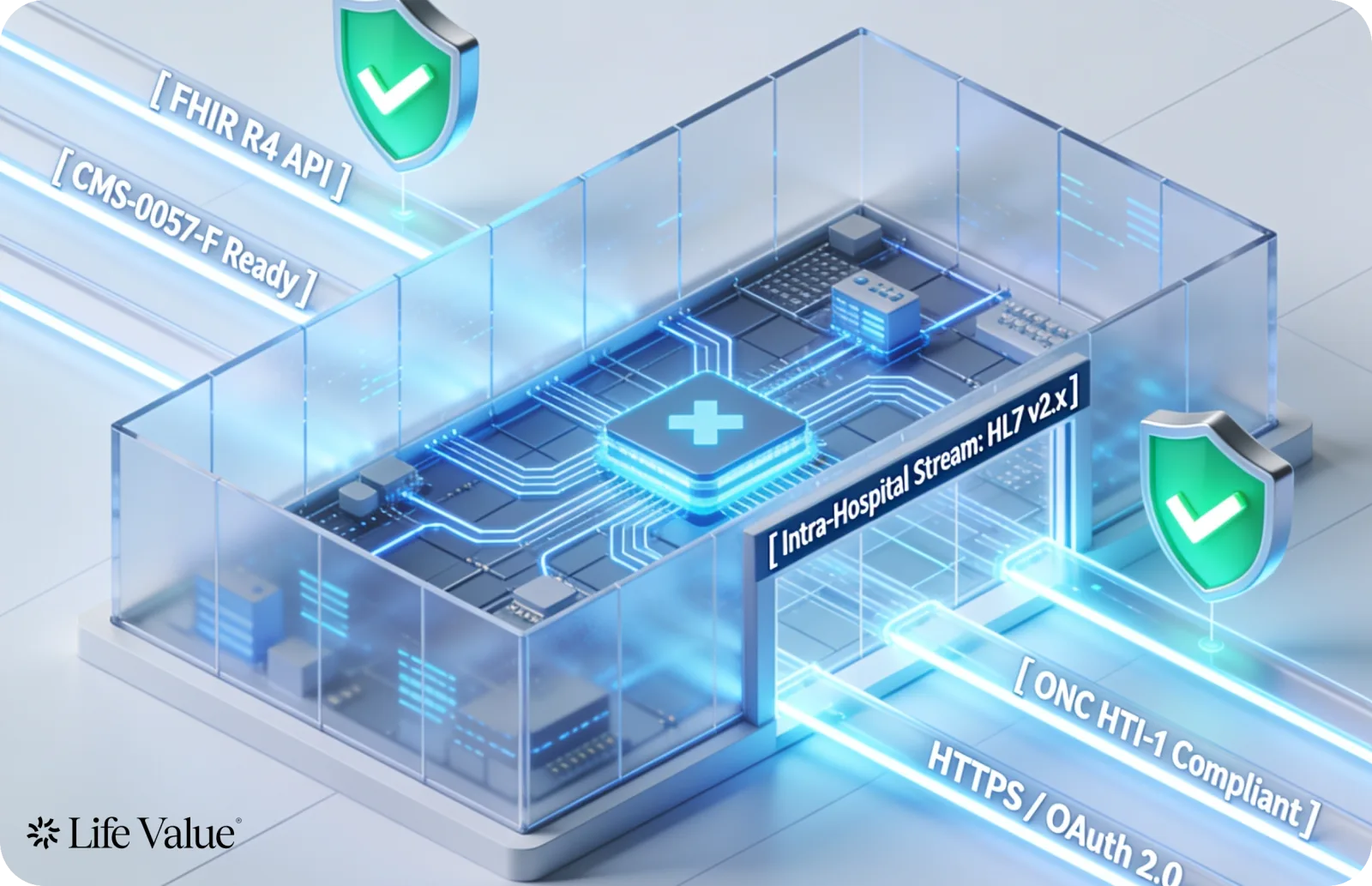
Almost every production healthcare data platform built in 2024 to 2026 lands on the same pattern. Accept HL7 v2 messages at the hospital boundary, normalise them inside the platform to a FHIR aligned internal model, and expose FHIR R4 endpoints externally to apps, payers, public health authorities, and TEFCA QHINs.

Three architectural choices implement this pattern.

The real engineering cost is not the protocol. It is the semantic mapping between what a source system actually produces and what a clean FHIR resource looks like. A v2 ORU^R01 lab result has many ways of encoding a reference range, units, and abnormal flags, and the correct mapping depends on the lab. Adapters that fail loudly when they see something new beat adapters that quietly emit bad data.

R4 or R5: which FHIR version to build on in 2026

Build to FHIR R4 in 2026. R4 is the version anchored by ONC HTI-1, CMS-0057-F, TEFCA, USCDI v3, the German ePA, and EHDS category one data. R5 was published in 2023 and brings improvements to Subscription, SubscriptionTopic, and terminology services, but regulator and EHR vendor adoption is still early. HL7 International publishes an R4 to R5 conversion guide for the migration when it eventually matters. Source: HL7 FHIR Release 5 specification and R4 to R5 conversion guide (hl7.org/fhir/R5).

What to ask a FHIR integration partner

Frequently asked questions

What is the difference between FHIR and HL7 v2?

HL7 v2 is a 1989-era pipe delimited messaging standard that still moves data inside US and European hospitals over MLLP sockets. FHIR is a REST API standard with JSON resources, stable since R4 in 2019. FHIR is what regulators mandate for patient-facing APIs and cross organisation exchange under ONC HTI-1, CMS-0057-F, TEFCA, and EHDS. HL7 v2 still dominates intra-hospital messaging.

Should I build on FHIR R4 or R5 in 2026?

R4. R4 is the regulated baseline for the US Cures Act, CMS-0057-F, TEFCA, USCDI v3, Germany's ePA, and EHDS. R5 brings improvements to subscriptions and terminology, but regulator adoption is still early. The R4 to R5 migration path is documented when you need it.

Do all major EHRs support FHIR R4?

Yes. Epic Hyperspace, Oracle Cerner PowerChart, MEDITECH Expanse, athenaOne, NextGen, and eClinicalWorks expose FHIR R4 endpoints. Implementations diverge in profile depth and write support. SMART on FHIR is the standard pattern for app launch and OAuth 2.0 scopes.

What is SMART on FHIR?

SMART on FHIR is the OAuth 2.0 plus OpenID Connect profile that lets a third party app authenticate against an EHR and request scoped access to FHIR resources. It is how a patient-facing app pulls clinical data after the Cures Act information blocking rules and how a clinician app launches inside Epic Hyperspace or Oracle Cerner PowerChart.

How much does a FHIR integration cost?

A FHIR integration for a single source system typically runs $30,000 to $150,000 depending on scope, profiles, and data volumes. Multi-EHR integrations scale less than linearly because the foundational mapping work carries over.

Will HL7 v2 disappear?

Not soon. The interface engines (Mirth Connect, Rhapsody, Cloverleaf, Iguana) embedded at hospitals across the US and Europe are expensive to remove and there is little benefit if FHIR endpoints sit alongside. Plan for v2 at the hospital boundary for at least the next decade.

How does CMS-0057-F change the picture?

CMS-0057-F, finalised in January 2024, requires Medicare Advantage organisations, Medicaid and CHIP fee for service programmes, Medicaid and CHIP managed care plans, and Qualified Health Plans on the Federally Facilitated Exchanges to implement Patient Access, Provider Access, Payer to Payer, and Prior Authorization APIs on FHIR R4. The Prior Authorization API has a 1 January 2027 compliance date.

Where Life Value sits in this

Life Value builds FHIR-native healthcare software for insurance carriers and payers, public health systems and ministries, private hospitals and integrated delivery networks, established healthcare companies, healthcare ISVs and digital health platforms, and growth stage healthtech companies. The hybrid pattern described above is the same one we implement: HL7 v2 at the hospital boundary, FHIR R4 externally, integration engine or cloud-native FHIR server in between, and disciplined semantic mapping in the middle.

The work spans Web App Development for patient and clinician surfaces, the FHIR International Patient Summary export resource for cross-border exchange under EHDS, and EHR and EMR Integration as the connective layer. We hold HIPAA, GDPR, HL7 FHIR R4, ISO 13485, and ISO/IEC 27001:2022 credentials, and we ship FHIR integrations against Epic, Oracle Cerner, MEDITECH, athenaOne, NextGen, and eClinicalWorks endpoints.

To discuss a FHIR integration, a CMS-0057-F implementation, an EHDS patient summary surface, or a v2 to FHIR migration, book a 30 minute review.

Last reviewed: 30 May 2026 by Alex Szilagyi, CEO, Life Value.

Ready to accelerate your next digital health breakthrough?

Whether you're launching a new solution or scaling an existing product, Life Value gives you the clarity, speed, and compliance needed to move with confidence.