Digital Health

Healthcare app development cost calculator (2026)

What a compliant healthcare app actually costs to build and operate in 2026, sized by buyer tier from carrier portal to hospital tooling to ISV product to founder MVP. The bounds shift with region, integration scope, and compliance perimeter.

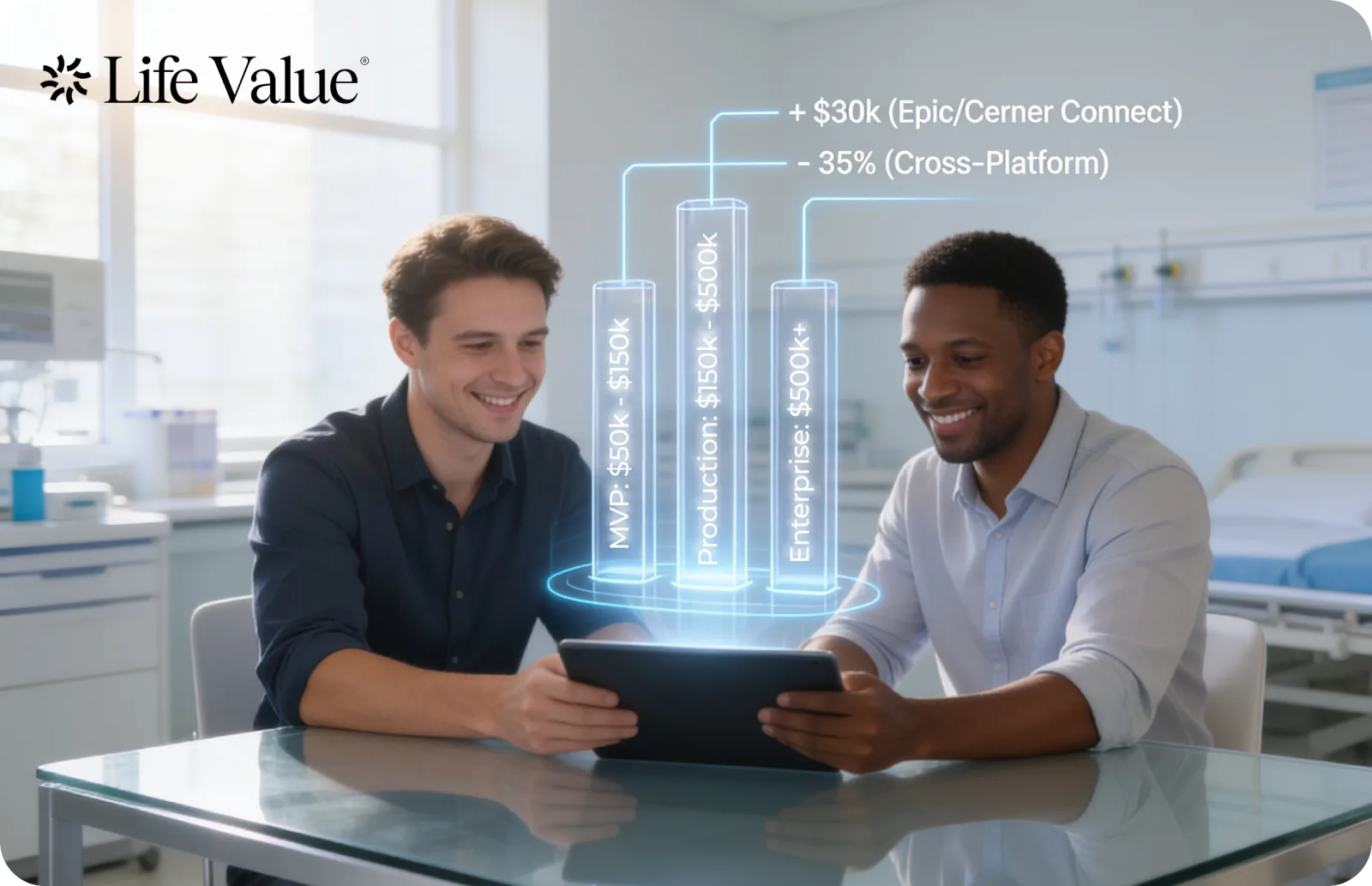
Illustration of a healthcare app development cost calculator with budget estimates and pricing breakdown

A healthcare app costs roughly $50,000 to $150,000 to build as a clinical MVP (4 to 6 weeks of focused work), and $150,000 to $500,000 to ship as a production grade product with EHR integration, AI features, or multi tenant scope. The ranges hold across the buyer tiers Life Value serves. Insurance carriers and payers, public health systems and ministries, private hospitals and integrated delivery networks, established healthcare companies, healthcare ISVs, and healthtech founders. The band shifts inside itself depending on PHI surface, regulated market footprint, and AI workload. Once live, annual maintenance runs 15 to 20 percent of the original development cost. Higher than the consumer app norm because of HIPAA, FHIR API drift, and EHR API deprecation cycles. Life Value does not publish a single number because every PHI scope is different. The ranges below are what we typically share in discovery.

The short answer

Three numbers anchor every conversation. A clinical MVP that a clinician can actually touch runs $50,000 to $150,000 across a 4 to 6 week build. A production app with one or two EHR integrations and a hardened security posture runs $150,000 to $500,000 across 12 to 20 weeks. An enterprise grade build with multi EHR integration, AI features, and procurement ready documentation runs $500,000 to $1.2M and up. The industry norm for the same scope is a 12 to 18 month timeline.

ScopeCost rangeClinical MVP (4 to 6 weeks)$50,000 to $150,000Production app (12 to 20 weeks)$150,000 to $500,000Enterprise grade build with multi EHR integration$500,000 to $1.2M and upYear 1 maintenance (industry benchmark)15 to 20 percent of dev costYear 3 maintenance (typical)20 to 25 percent of dev costHealthcare specific premium versus consumer apps15 to 30 percentIndustry build norm (12 to 18 months)versus Life Value 4 to 6 weeks to clinical MVP

Source note. The 15 to 20 percent annual maintenance benchmark is the industry standard cited across Clutch, Statista, and HIMSS aligned vendor reports. Life Value does not invent the percentage. The healthcare specific premium reflects HIPAA ready hosting, FHIR R4 integration, and compliance documentation overhead. Discussed in detail below.

What drives the cost

Eight inputs move the number more than anything else. Region of the build team, target platforms, EHR integration scope, AI feature surface, regulated market footprint (HIPAA in the US, GDPR and MDR in the EU, EU AI Act on top), design polish requirements, team rate band, and parallel compliance certification programs.

DriverWhy it moves the numberTypical impact on totalApp complexity (simple, medium, complex)Number of screens, number of integrations, number of user roles2 to 5x swing between simple and complexPlatform (web, iOS, Android, cross platform)Each native platform is a separate build path. Cross platform saves 30 to 40 percent versus two native buildsPlus 30 to 40 percent per additional native platformEHR integrationFHIR is the data model. SMART on FHIR adds an auth layer. Particle Health, Health Gorilla, Epic, Cerner all have their own quirksPlus $30,000 to $120,000 depending on EHRs touchedAI featuresModel selection, RAG over FHIR, guardrails, audit logging, model evalsPlus $25,000 to $100,000 for a meaningful AI feature setHIPAA, GDPR, EU AI Act postureDocumentation, BAA chain, threat model, penetration testPlus 10 to 20 percent across the buildDesign polishClinician UI must be usable in 8 second interactions and accessible. Raises design hoursPlus 5 to 15 percentTeam rate (US versus EU versus nearshore)Nearshore EU teams like Life Value run 30 to 50 percent below US shop ratesUp to 40 percent lower on like for like scopeCompliance certifications (SOC 2, ISO 27001)Not a build line item but a parallel program. Budget separately$25,000 to $75,000 first time, plus internal time

Cost ranges by app type and buyer tier

Bands by app type, with three sizing options inside each. MVP, production, and enterprise. These are the numbers Life Value shares in discovery against actual PHI scopes. They map directly to the buyer tiers we serve. Carrier portals and payer member apps sit in the patient facing portal and patient mobile bands. Hospital and IDN clinician tooling sits in the clinician facing workflow band. ISV products usually start in the clinician facing or AI clinical decision support bands and scale into telehealth platform territory. Founder MVPs almost always start in the MVP column and grow into production over 12 to 18 months.

App typeMVPProductionEnterprisePatient facing portal (single EHR connect, read only)$50,000 to $90,000$120,000 to $250,000$300,000 to $500,000Patient mobile app (HIPAA, on device data)$60,000 to $120,000$150,000 to $300,000$400,000 to $700,000Clinician facing workflow app$80,000 to $150,000$200,000 to $400,000$500,000 to $900,000AI clinical decision support$100,000 to $180,000$250,000 to $500,000$600,000 to $1.2MTelehealth platform (multi tenant)$120,000 to $200,000$300,000 to $600,000$700,000 to $1.5MIoT and wearable integration backend$80,000 to $150,000$200,000 to $450,000$500,000 to $1M

Why we publish ranges, not a single number. Every PHI scope is different. A clinical app with one EHR read is not the same as a multi tenant SaaS reading and writing to five EHRs and running AI on top. We share the band that fits your scope on the discovery proposal.

Maintenance. The part most calculators ignore

Industry benchmark is 15 to 20 percent of original development cost per year. That is the baseline. For a $200,000 production app, plan on $30,000 to $40,000 a year, climbing to $40,000 to $50,000 by year three as accumulated changes compound.

What 15 to 20 percent per year actually covers

  • Operating system updates. Apple ships iOS major versions annually. Google ships Android with platform API changes. Both can break a healthcare app biometric or background task code.
  • Library and SDK updates. Third party SDKs (FHIR clients, analytics, crash reporting, identity) get security patches and deprecations.
  • FHIR API drift. When the EHR vendor updates their FHIR endpoint, the resource profile sometimes changes silently. Healthcare specific cost.
  • EHR API deprecation cycles. Epic and Cerner periodically retire older API versions on published schedules. Healthcare specific cost.
  • Security patches. CVEs against libraries you depend on. OWASP recommended monitoring on the dependency graph.
  • Server costs. Cloud spend, monitoring, log retention. Often 5 to 8 percent of total annual maintenance line item.
  • Bug fixes. Anything users find.
  • Content updates. Clinical content (decision support rules, drug formularies) needs scheduled review.

Operating cost section. Hosting, BAA chain, monitoring

Once a healthcare app is live, the operating line splits into three buckets. HIPAA eligible cloud spend, the BAA chain across every subprocessor, and security and observability tooling.

  • HIPAA eligible cloud spend. AWS, GCP, and Azure all expose HIPAA eligible service tiers. Aptible sits on top of AWS with a managed BAA. Expect 15 to 25 percent above default tier pricing for the same workload because of the eligible service substitution.
  • BAA chain. Every subprocessor that touches PHI needs a Business Associate Agreement. Identity (Auth0 or Okta on the BAA tier), email (Postmark or SendGrid HIPAA), error tracking (Sentry HIPAA), analytics (Mixpanel BAA), AI inference (AWS Bedrock added HIPAA eligibility in 2024, Anthropic ships a BAA path for enterprise). Each adds a paperwork pass at procurement.
  • Monitoring and audit. Centralized log aggregation with PHI redaction. Audit logs on every PHI access, retained per HIPAA Security Rule guidance. Penetration test on every major release. $8,000 to $25,000 per engagement depending on scope.

Year 1 versus year 3. The maintenance trajectory

Two things bend the curve upward over time. First, technical debt compounds. Every shortcut taken in year one becomes a cost in year three. Second, the regulatory environment shifts. New HIPAA Security Rule guidance, EU AI Act enforcement, MDR re classification. The maintenance budget has to absorb the response.

Cost lineYear 1Year 2Year 3Engineering retainer (security, OS, SDK)8 to 10 percent of dev cost8 to 10 percent8 to 10 percentFHIR and EHR API drift handling2 to 3 percent3 to 4 percent3 to 5 percentServer and infra2 to 3 percent3 to 4 percent4 to 5 percentContent updates (clinical rules)1 to 2 percent2 to 3 percent2 to 4 percentCompliance maintenance (audits, pen tests)2 to 3 percent2 to 3 percent3 to 5 percentTotal typical band15 to 20 percent18 to 22 percent20 to 25 percent

Worked example. Patient facing FHIR app

A like for like benchmark against a US shop running a 12 to 18 month timeline at typical Bay Area rates puts the same scope at $260,000 to $380,000 for the build alone, with the same percentage maintenance applied on top. The 40 percent lower cost we cite is referenced against this benchmark.

Line itemAmountScopeiOS plus Android patient app, read only against one EHR, biometric authMVP build (Life Value, 4 to 6 weeks)$80,000Production hardening (next 8 weeks)$110,000Total year 0 dev$190,000Year 1 maintenance (16 percent of dev cost)$30,400Year 2 maintenance (18 percent)$34,200Year 3 maintenance (22 percent, includes a major EHR API deprecation)$41,800Three year total cost of ownership$296,400

Why healthcare apps cost more than consumer apps

  • HIPAA ready hosting adds 15 to 25 percent to the cloud line. AWS, GCP, and Azure HIPAA eligible services often cost more than their default tier equivalents, and the BAA required configuration takes engineering time.
  • FHIR native data modeling. Building against FHIR R4 (released 2019, current 4.0.1) from day one means an upfront cost, but the alternative (bolting it on later) is 3 to 5x more expensive.
  • Audit logging on every PHI access. Custom plumbing, plus the log retention cost.
  • Penetration testing on every release. Standard practice. $8,000 to $25,000 per engagement depending on scope.
  • Documentation. The procurement team at any serious buyer will ask for a security questionnaire, a SOC 2 or ISO 27001 audit, an architecture diagram, a threat model, and a BAA chain. The hours add up.
  • Clinician validation. Real clinicians on real workflows during the build. Not optional, but raises design and QA hours.

How to lower the cost without lowering the quality

  1. Use off the shelf for the commodity layers. Hosting (Aptible or AWS BAA), FHIR server (MedPlum or managed), identity (Auth0 or Okta BAA). Bespoke only for the product surface.
  2. Pick one platform first. Web before mobile, or iOS before Android. Not both at once unless the buyer requires it.
  3. Defer AI features to a second cycle. Get a working clinical product first, then layer AI in once the workflow is validated.
  4. Use a nearshore EU team. Like for like scope runs 30 to 50 percent below US shop rates without quality compromise.
  5. Avoid bespoke FHIR. Pick the 20 FHIR R4 resources that cover 90 percent of clinical apps. Do not invent a custom data model.
  6. Scope to a clinical MVP first. 4 to 6 weeks. A clinician can touch the product at the end. Anything bigger is a year 1 project, not an MVP.

Sources and citations

  • HIMSS. Healthcare technology survey data on development cycle norms.
  • Statista. Published mobile app development cost ranges (2024 to 2026).
  • Clutch. Mid market software services rate benchmarks.
  • OWASP. Security maintenance and dependency monitoring guidance for healthcare apps.
  • Apple App Store Review Guidelines. Annual OS release cadence and policy changes.
  • Google Play Console Policy Updates. Android platform API changes.
  • Epic and Cerner FHIR API release notes. For documented EHR API deprecation schedules.

FAQ

How much does it cost to develop an app in 2026?

A simple app starts around $50,000. A medium complexity production app runs $150,000 to $300,000. A complex enterprise build runs $300,000 to $1.2M and up. Healthcare apps typically sit 15 to 30 percent higher than equivalent consumer apps because of HIPAA, FHIR, and audit requirements.

How much does it cost to build a healthcare app?

A clinical MVP runs $50,000 to $150,000 (4 to 6 weeks at Life Value). A production grade app with EHR integration runs $150,000 to $500,000. Enterprise grade multi tenant scope runs $500,000 to $1.2M and up. Ranges depend on platforms, integrations, AI features, and compliance posture.

How much does it cost to maintain an app?

Industry standard is 15 to 20 percent of original development cost per year. For a $200,000 app, plan on $30,000 to $40,000 in year one, rising to $40,000 to $50,000 by year three.

What is the app maintenance cost percentage of development cost?

15 to 20 percent per year is the widely cited benchmark. Healthcare apps trend toward the high end (18 to 22 percent) because of FHIR API drift and EHR API deprecation cycles.

How much does it cost to maintain a mobile app?

For a typical $150,000 to $250,000 mobile app, annual maintenance runs $22,500 to $50,000. Healthcare apps run $27,000 to $55,000 in the same range because of compliance overhead.

What is the mobile app maintenance cost?

Mobile app maintenance runs 15 to 20 percent of dev cost per year. Year one is typically lower (15 to 17 percent). Years two and three trend up (18 to 22 percent) as technical debt accumulates and regulatory changes hit.

What is included in app maintenance costs?

OS updates (iOS, Android), library and SDK patches, security CVE response, server and cloud spend, FHIR and EHR API drift handling, content updates, bug fixes, and compliance maintenance (audits, pen tests). Healthcare apps add HIPAA specific work on top.

Why are healthcare apps more expensive to maintain?

Three reasons. FHIR API drift (the EHR vendor changes the endpoint and you have to follow), EHR API deprecation cycles (Epic and Cerner retire older APIs on a schedule), and compliance maintenance (HIPAA, pen tests, BAA renewals). Combined effect is roughly plus 20 to 30 percent on the maintenance number versus a consumer app.

How long does a healthcare app take to build?

Industry norm is 12 to 18 months. Life Value reaches a clinical MVP (something a clinician can touch) in 4 to 6 weeks. Production hardening adds another 8 to 14 weeks.

Can I get a fixed price?

Yes, once we have run a discovery sprint. Discovery is a fixed fee. The MVP build is a fixed scope at a fixed fee. We do not quote a fixed price for the whole build before discovery because the PHI scope, the EHRs, and the AI surface all move the number.

Where Life Value sits in this

Life Value builds and operates healthcare apps for insurance carriers and payers, public health systems and ministries, private hospitals and integrated delivery networks, established healthcare companies, healthcare ISVs, and healthtech founders. The work spans Web App Development for portal and SaaS surfaces, Mobile App Development for patient and clinician facing iOS and Android products, and the orchestration layer above Redox, Particle Health, Health Gorilla, MedPlum, Aptible, and the rest of the healthcare microservice stack. The ranges on this page are what shows up on a discovery proposal once we have the PHI scope, the EHRs touched, and the regulated market footprint in hand. If you want a band against your actual scope, book a discovery call.

Last reviewed. 21 May 2026, by Alex Szilagyi, CEO. Reviewed against current AWS, GCP, and Azure HIPAA pricing and current FHIR R4 release notes.

Ready to accelerate your next digital health breakthrough?

Whether you're launching a new solution or scaling an existing product, Life Value gives you the clarity, speed, and compliance needed to move with confidence.